
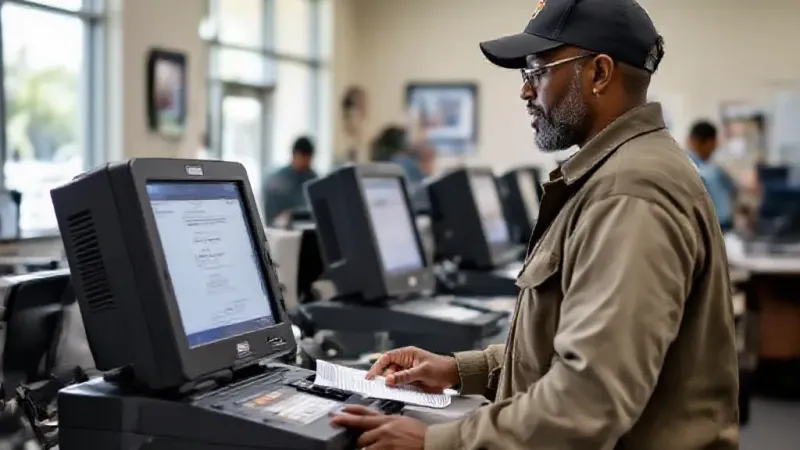
Georgia’s State Election Board has advanced a resolution calling on the secretary of state’s office to update the state’s voting machines and urged the U.S. Department of Justice and U.S. Department of Homeland Security to intervene to ensure these updates occur. The resolution, introduced by the board’s GOP appointee Carolyn Roddy, passed in a 3-2 vote on Monday.
The vote comes roughly two weeks before Georgia residents begin heading to the polls for early voting, which starts on October 13. The resolution cited a September 2 letter from Homeland Security Secretary Markwayne Mullin to U.S. Attorney General Todd Blanche, which stated that QR code-based voting systems may potentially violate the federal Help America Vote Act.
Following the board’s Monday decision, executive director James Mills wrote a letter on Wednesday to Attorney General Blanche, specifically requesting federal “intervention.” Mills urged the attorney general to open an investigation into the secretary of state’s office and require them to install updated software ahead of the midterm elections. The resolution additionally called for the secretary of state’s office to hold onto copies of server hard drives and other election data for federal agencies to review.
Board member Janelle King supported the measure at Monday’s meeting, arguing that bringing in federal officials could help incentivize the secretary of state’s office to update Georgia’s election software. King stated the request was to support the secretary of state’s office “to do their job.” Roddy also expressed frustration with the perceived lack of action on software updates, stating, “it is irresponsible to have all of us voting on machines that we know have known vulnerabilities.”
The move by the State Election Board follows a joint letter penned by the Georgia Republican Party and Republican National Committee to the board, raising concerns about Georgia’s voting equipment software. This letter cited claims from a Princeton University researcher who reportedly used artificial intelligence to link thousands of voters to specific ballots with relative certainty, using publicly available data. The GOP and RNC letter also called for the board to publish a report on the status of Georgia’s election system and “seek any federal technical assistance required to complete a certified upgrade” of the state’s voting equipment.
Despite the resolution’s passage, both board chair John Fervier and board member Sara Tindall Ghazal opposed the measure. Ghazal, the board’s sole Democratic appointee, raised concerns about inviting federal government involvement in state election processes. She also disputed the characterization of the software update as a simple “patch,” arguing that it would be an “entirely new software system” that could take months to finalize. Ghazal contended that what was being called for was “impossible to do before the midterm elections.”
Georgia’s voting machines, developed by Dominion Voting Systems (now known as Liberty Vote), were first used statewide in Georgia during the 2020 election and will still be in use for the upcoming midterm elections. Experts have noted that a lack of recent software upgrades has left vulnerabilities in the system. Secretary of State Raffensperger had previously urged state leaders in the 2025 legislative session to allocate $15 million for the personnel costs necessary to update voting machines across the state, but lawmakers never approved these funds.
Robert Sinners, a spokesperson for the secretary of state’s office, criticized Roddy’s resolution, asking, “Where were these board members supporting our funding requests over past legislative sessions?” Sinners stated the resolution was “a day late and at least $30 million dollars short” and dismissed Mills’ letter as an unserious proposal. He emphasized Raffensperger’s repeated efforts to secure funding for security upgrades, adding that “People who are serious about election security don’t inject chaos in the 11th hour.” State officials are currently working on plans to replace the state’s election equipment ahead of the 2028 presidential election, under which Georgia will move away from its current practice of using ballot QR codes to tally votes.