
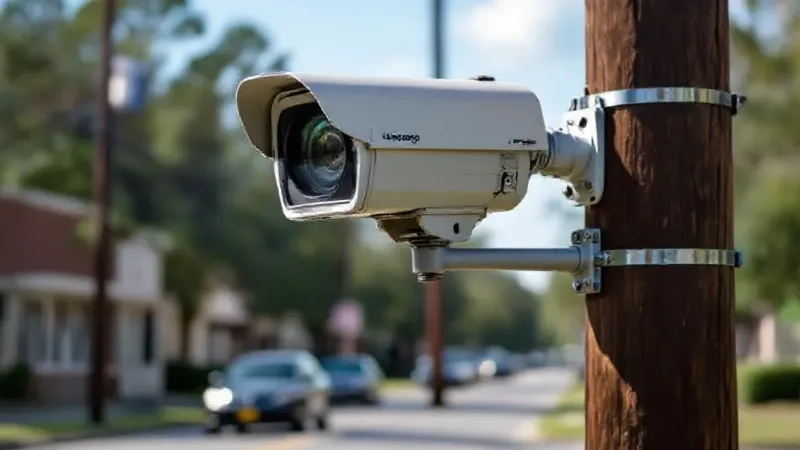
Across the country, the installation of automatic license plate reader (ALPR) cameras by Flock Safety has drawn increasing scrutiny, with a growing number of local governments reconsidering or terminating contracts due to concerns over procurement processes, transparency, and data privacy. Several communities have found that these surveillance systems were installed and paid for without explicit prior approval from their city councils or county commissions, leading to public debate and official investigations.
In Maryville, Tennessee, resident Kyle Skeen, a former senior intelligence analyst for the United States Navy and NATO, expressed surprise at the prevalence of these cameras upon his return to the U.S. in 2024. Maryville, just south of Knoxville, has 16 Flock Safety cameras, leading Skeen to state he “cannot leave my neighborhood without passing a Flock camera.” Skeen, familiar with surveillance concepts from his career, reported being shocked by the nationwide scope of law enforcement searching and how his community came to acquire the technology. He stated that the “power should lie with the people,” and these systems tilt the balance. Maryville police began using Flock technology in 2020, but the city council did not vote on the issue until July 2024, when a state right-of-way permit was required. Maryville Mayor Andy White acknowledged that the council was gathering information and learning more from both citizens and the police chief during a public work session.
Flock Safety’s national network includes over 120,000 cameras, with the company’s executives emphasizing local control over implementation. Flock Chief Communications Officer Josh Thomas stated in an April interview that city councils are democratically elected to make such decisions, and if the community disapproves, they should “go vote differently.” However, InvestigateTV found multiple instances nationwide where cameras were installed and paid for before local elected officials approved them, if approval occurred at all.
One significant case emerged in Knox County, Tennessee, where then County Mayor Glenn Jacobs sent a letter to Flock in mid-August, questioning the validity of the county’s contract. The Knox County Sheriff’s Office had been making payments since 2020, which Jacobs alleged appeared to be structured to “escape” the county’s contract oversight procedures. Records indicated the sheriff’s office purchased Flock cameras in batches of $24,990, precisely $10 under the $25,000 threshold that would have required review by the county mayor’s office. The office also used split invoices of $12,500 that, when combined, would have triggered a review.
Knox County Commissioner Larsen Jay commented during a public meeting that the payment record showed “a pattern of buying things right under the threshold again and again and again. That concerns me.” County Law Director David Buuck described the arrangement as “one of the screwiest contracts I ever read” because it automatically renewed with each under-the-limit order. Former Mayor Jacobs insisted that if it was a contract, it should have come before the commission and his office, which did not happen. By the time commissioners addressed the matter, the Knox County Sheriff’s Office had 143 active Flock license plate readers, and over a quarter-million taxpayer dollars had been spent, according to Jacobs' letter.
When InvestigateTV directly asked Flock if the company works with agencies to avoid budgetary reviews, a spokesperson responded via email, stating that Flock provides public agencies with product information, pricing, and procurement documentation, but “Purchasing thresholds, sole-source requirements, and whether council or commission approval is required are governed by each agency’s applicable laws, policies, and procurement procedures.”
Ultimately, Knox County pulled the plug on its Flock contract, declaring it invalid and demanding the removal of the cameras. When Flock missed a county-imposed deadline, the newly-elected mayor deployed public works crews to cover the devices. The sheriff’s office has since announced it is no longer using any fixed ALPR systems.
Knox County is not alone in its reversal. The Institute for Justice has documented over 250 communities that have either canceled or will not renew their contracts with Flock Safety. For instance, the mayor of Neenah, Wisconsin, publicly stated the city terminated its relationship with Flock due to security concerns and “mounting evidence” that the company “wasn’t doing what it was supposed to in the contract.” In Ledyard, Connecticut, the police department received a security breach notification from Flock in September, which was the “final straw” for Police Chief Ken Creutz. Creutz, who had growing concerns after watching recent congressional hearings, stated in a letter to local elected officials that “The technology may do some things that we were told that it can’t do.” The Ledyard police department severed its contract, and the town’s public works department covered all four of its cameras. These instances highlight a nationwide trend of reevaluating the transparency and oversight of ALPR technology implementation in local communities.