
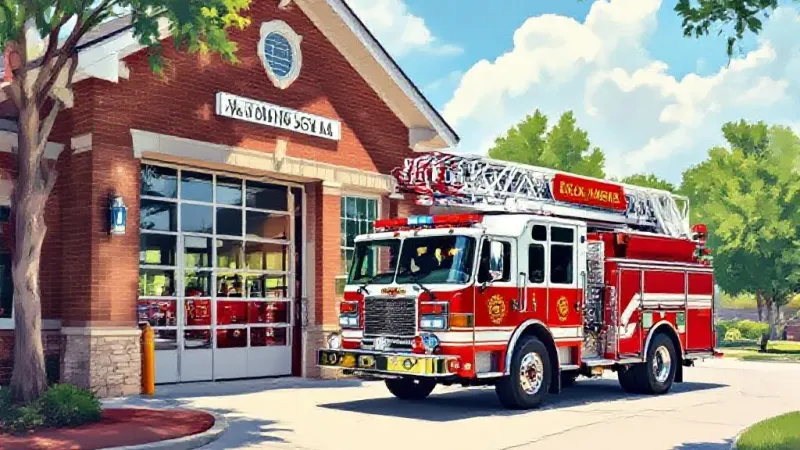
ATLANTA — A Georgia Supreme Court ruling that struck down a firefighting fee in Chatham County is raising alarms among local governments statewide, sparking concerns over how cities and counties will fund essential services. The high court's decision, which ordered Chatham County to refund approximately $30 million in fees and interest, could have broad implications for other jurisdictions that rely on various service fees to supplement their budgets.
The ruling upheld a superior court decision that found Chatham County's fire fee was effectively an illegal property tax. Unlike a property tax, it was not based on property value. Instead, property owners were billed based on the anticipated cost of extinguishing a fire on their property, with fees partly determined by square footage. Chatham County ceased collecting the disputed fire service fee in June 2024.
The fallout from this decision has prompted swift reactions from local leaders. Mayor Randall Walker of Perry, a city south of Macon, stated that the ruling is "a very large concern of Perry and all municipalities." Andrea Arnold, the city manager of Decatur in metro Atlanta, expressed similar apprehension. Decatur is actively seeking to diversify its revenue streams beyond property taxes, exploring options such as fees for recreation, sanitation, and stormwater. Arnold noted that "the recent state Supreme Court decision has us extremely concerned about the future of fees," suggesting it could undermine these efforts.
The core challenge for cities and counties is their limited means of generating revenue beyond property and sales taxes. Without the ability to charge fees for specific services, local governments face increasing pressure to cover operational costs, particularly for services provided to properties that are exempt from property taxes.
Clint Mueller, deputy director of the Association County Commissioners of Georgia, illustrated this funding gap by pointing to state colleges. State colleges do not pay property taxes, yet county fire departments are still obligated to respond to any fires on their properties, incurring costs that must be borne by other taxpayers. Rep. Mike Cheokas, R-Americus, shared that a county leader in his area had expressed a preference for fees over property taxes precisely because some property owners, such as nonprofits, are exempt from paying property taxes, even though local services must still be provided to them. Cheokas emphasized that, in such cases, "you’re not getting reimbursed for that."
Local leaders and advocates presented these concerns to members of the House Blue-Ribbon Study Committee on Local Government Taxation, Funding, and Budgeting during its meeting in Perry on Wednesday. Mueller suggested that the only way to address the ruling's impact comprehensively is to change either state law or the state constitution to explicitly authorize and legalize service fees. The study committee is slated to meet again at the Capitol on a future Wednesday, where discussions about the future of local government fees are expected to continue.