
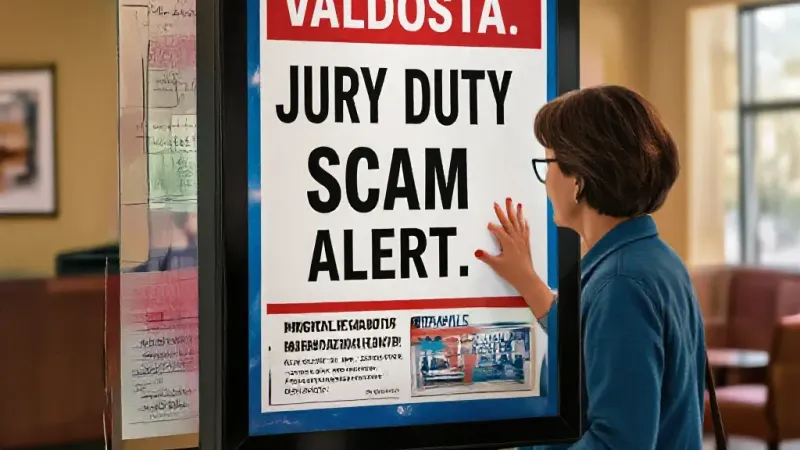
Two inmates at a South Georgia prison have received lengthy federal sentences for orchestrating a nationwide scam that defrauded victims of over $464,920, according to an announcement from the U.S. Attorney’s Office for the Middle District of Georgia. The scheme, which involved impersonating law enforcement officers and threatening immediate arrest for missing jury duty, specifically targeted individuals across the country, including residents in the Valdosta Division which serves Lanier, Lowndes, and Berrien counties.
Lance Riddle was sentenced to 200 months, or 16 years and eight months, in federal prison, while Joey Amour Jackson received 120 months, or 10 years. Senior U.S. District Judge W. Louis Sands ordered these federal terms to run consecutively to their existing state sentences, followed by three years of supervised release. Both men were convicted on January 9 of conspiracy to commit wire fraud and conspiracy to commit money laundering after a five-day trial.
Operating from Calhoun State Prison in Morgan, Georgia, Riddle and Jackson used contraband cellphones and internet-based calling technology to make their calls appear to originate from victims' local police departments. They impersonated both invented and actual law enforcement personnel, demanding payment for supposed missed jury duty to avoid immediate arrest. To add pressure, callers imposed a fabricated gag order, prohibiting victims from discussing the warrants until payment was made. Most victims were instructed to purchase gift cards and relay the identifying numbers, while others sent wire transfers. After payment, inmates directed victims to their local police departments to verify signatures on the nonexistent bonds, further integrating real police stations into the deception.
The U.S. Attorney’s Office documented more than $464,920 in losses from 119 victims nationwide, although authorities believe the actual number of victims and losses may be higher. The scheme primarily targeted women with professional backgrounds and prominent online profiles, though male victims were also identified. For some victims, the abuse extended beyond financial loss, with callers demanding invasive self-searches in store restrooms, followed by sexually explicit messages and violent threats. Outside accomplices assisted in managing financial accounts, with proceeds funneled towards personal debts, including house and vehicle loans, and drug purchases.
U.S. Attorney William R. “Will” Keyes, who announced the sentences, stated, "Even from prison, the defendants preyed on citizens through threats and deceit." The case was investigated by the FBI’s Columbus Resident Agency and prosecuted by Criminal Chief Leah McEwen.
Following these convictions, the Middle District of Georgia’s federal court website continues to warn district residents, including those in Lanier, Lowndes, and Berrien counties, about ongoing fraudulent calls claiming missed jury duty or outstanding arrest warrants. These callers often offer to prevent arrest in exchange for payment, typically through prepaid or gift cards. The Federal Trade Commission (FTC) also issued a consumer alert in June, noting that jury-duty scammers might follow phone threats with texts or emails containing fake arrest warrants, sometimes using personal information like the recipient’s name and address to appear more credible.
Residents are reminded that legitimate courts will not assess penalties or require payment for missed jury duty over the telephone or by prepaid debit card. The FTC warns that demands for gift cards, cryptocurrency, payment apps, or wire-transfer services are strong indicators of fraud. If you receive a threatening payment demand, end the call immediately and contact the court or law enforcement agency using a number you independently verify, not one provided by the caller or displayed on caller ID. Attempts at fraud can be reported to ReportFraud.ftc.gov. For questions regarding federal jury service in the Valdosta Division, the clerk’s office can be reached at 229-242-3616. Inquiries about state or local jury service should be directed to the court named on the summons, using independently verified contact information.