
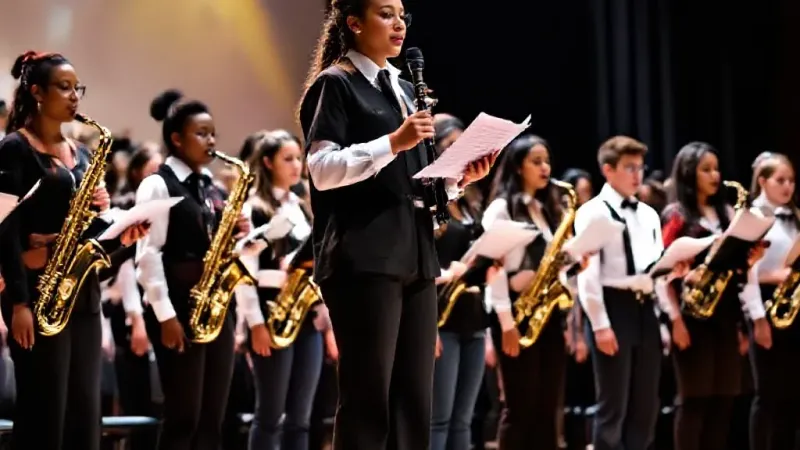
Valdosta City Schools' music programs are earning statewide recognition, demonstrating strong performance despite significant financial challenges. Over 90% of students in the South Georgia district qualify for free and reduced lunch, yet its music initiatives "punch above its weight class," according to Alan Fowler, executive director of the Georgia Music Educators Association.
The Valdosta High School marching band boasts more than 200 members, and its wind symphony has received an invitation to perform at a major music festival in Indianapolis next year. Tangela Kimber, director of fine arts and world languages at Valdosta City Schools, stated that the district "try[s] not to make (finances) be a barrier" for students interested in music.
A crucial element in Valdosta's ability to maintain and expand its programs is external support. The Tunes for Tots Foundation, an initiative of the Athens-based rock band Widespread Panic, provided a $20,000 grant to the Valdosta Middle School band program last year. This assistance was pivotal, allowing the district to launch a school orchestra program during the 2020-2021 school year, Kimber reported.
Valdosta's orchestra program stands out, described by Kimber as one of the only ones of its kind in the region. The program began unconventionally, with director Keisha Thomas holding weekend meetings with students. Thomas continues to host weekend rehearsals for middle school orchestra students, enabling them to perform alongside their high school peers. Students also engage in educational field trips to observe the orchestra at Valdosta State University.
While Valdosta City Schools showcases resilience, music education programs across Georgia face varying levels of support. Alan Fowler of the Georgia Music Educators Association noted that with over 180 school systems in the state, "not every school system has it as good as the others." He pointed out that communities have unique challenges, with finances being a significant factor, as "some communities just have more."
School funding in Georgia relies on local property taxes and state money distributed through the Quality Basic Education formula. This structure means districts in more affluent areas, benefiting from higher property values, are less dependent on resources like booster clubs or external grants to sustain their music programs.
Beyond local funding disparities, music educators are also confronting potential federal funding cuts to the Department of Education, which could specifically impact arts programs. Longtime music educator David Starnes highlighted that some proposed cuts would affect professional development initiatives, a critical concern for a profession where many educators often feel isolated. "In a lot of schools, there’s one band director or one orchestra director or one choral director, and there’s not that networking opportunity," Starnes observed.
The cost of instruments is another growing obstacle. An analysis by the Peterson Institute for International Economics indicated that tariffs have led to increased prices and reduced imports of musical instruments, particularly those for beginners. Compounding this, the U.S. Department of Commerce last month proposed a 25% tariff on brass wind instruments, including trumpets, trombones, and tubas, a move that educators worry could seriously harm entire music programs.
Participation costs are also on the rise for students. Starnes reported seeing marching band dues escalate from approximately $500 to over $2,000 in some programs. These fees cover expenses such as show design, travel to games and competitions, and staff salaries. Such increases can make programs unsustainable, leading some to "have to tap the brakes... to go, 'We just can’t sustain this and we’re gonna lose kids and parents out of our program,'" Starnes added.
Despite these challenges, some districts are exploring new methods to engage students. At Bear Creek Middle School in Fairburn, southwest of Atlanta, students learn music using small keyboards connected to iPads. Matt Koperniak, performing arts coordinator for Fulton County Schools, explained that these music technology classes were made possible by a grant from Save the Music, a national nonprofit that has raised over $75 million for schools across the country, including districts in the Atlanta metro area.
Koperniak noted that these classes expose students to "industry standard skills" relevant to Atlanta's film industry, where music is a high-demand career. Students utilize digital tools to create music by recording themselves singing or playing instruments, then looping and mixing sounds. While digital tools are valuable, Koperniak emphasized that traditional ensemble settings still offer irreplaceable benefits.
Students in band, chorus, and orchestra programs develop both musical and "valuable non-musical skills that future employers of all professions value," Koperniak stated. These include creativity, teamwork, and empathy – "soft skills... of the highest importance to employers."