
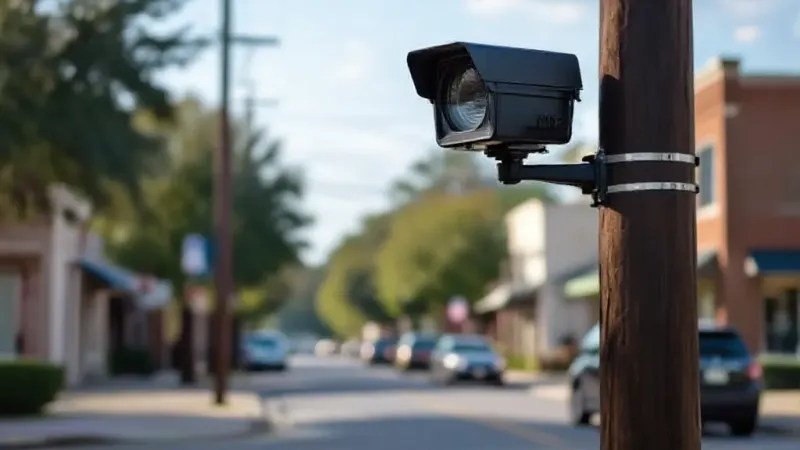
U.S. Senator Raphael Warnock is advocating for stronger federal oversight of automatic license plate readers (ALPRs), citing multiple instances where law enforcement officials have reportedly misused these camera systems to surveil or harass U.S. citizens. This call for federal action directly addresses privacy concerns for residents across South Georgia and the nation, especially regarding technologies often purchased with taxpayer dollars.
Senator Warnock, a Democrat representing Georgia, has partnered with U.S. Senator Katie Britt, an Alabama Republican, to push the U.S. Department of Justice (DOJ) to establish clear guidelines for the use of ALPRs. Earlier this week, the senators dispatched a formal letter to U.S. Attorney General Todd Blanche, urging the department to issue comprehensive guidance for state and local law enforcement agencies. Additionally, their letter requests the DOJ to disclose the total amount of federal funding that has been allocated for the acquisition of these license plate reading technologies. The Department of Justice has not yet provided a response to this request.
Within their communication, the senators voiced deep concern over ALPR misuse, emphasizing the need for safeguards to prevent unauthorized access and abuse. They further stressed the importance of pairing federal funding for these technologies with robust oversight mechanisms to ensure funds are not used to facilitate such abuse. This highlights a key concern for residents regarding how public funds are utilized and the accountability measures in place.
Automatic license plate readers, including those developed by Atlanta-based Flock, operate by capturing vehicle data such as license plate numbers, car make, and color. This information is then stored in searchable databases. Law enforcement agencies that have contracts with companies like Flock utilize these databases for legitimate purposes, including tracking down stolen vehicles, locating missing persons, and assisting in solving various crimes. However, the technology has also generated considerable controversy due to instances of law enforcement personnel accessing these databases for personal reasons.
The Georgia Bureau of Investigation (GBI) has reported that at least 19 individuals working in law enforcement or emergency services in Georgia have been arrested and charged this year. These charges stem from the misuse of a state law that explicitly limits the use of these cameras to official law enforcement purposes only. Senator Warnock, speaking at a press conference on Wednesday, underscored the gravity of the situation, noting numerous instances where law enforcement officers reportedly used their access to the surveillance technology to stalk individuals, including women by ex-partners. This directly impacts the safety and privacy of local residents.
Senator Warnock strongly condemned the current lack of national guidance on ALPR use. He pointed out that many municipalities have procured these license plate readers with federal funds, yet there are no federal policies to either punish or even monitor the misuse of license plate tracking data by the estimated 140,000 law enforcement officers with access nationwide. In the absence of clear, uniform guidelines, state and local governments are left navigating a fragmented approach, which, according to Warnock, erodes public trust in the technology. He asserted that, “And right now there are no guardrails at all.” This affects residents by creating inconsistent standards for privacy and accountability depending on where they live.
The call for greater oversight is not entirely new within Georgia. Last month, two Republican members of the Georgia Senate also advocated for increased supervision over these camera systems. Specifically, Roswell Republican Sen. John Albers announced his intentions to collaborate with various law enforcement associations to develop solutions addressing the misuse of this technology. Flock, the Atlanta-based manufacturer of some ALPR systems, did not immediately respond to a request for comment regarding these developments.