
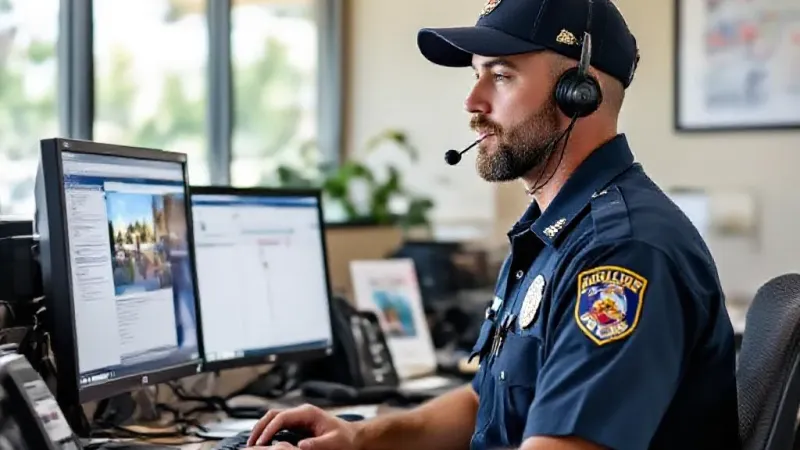
Georgia residents will vote on a proposed constitutional amendment this year that aims to establish a dedicated fund for upgrading the state's 911 emergency communication system. The measure seeks to modernize an infrastructure largely unchanged since its 1968 establishment, when most calls were made from landlines. Today, more than 80% of 911 calls originate from wireless devices, according to the Georgia Emergency Communications Authority, highlighting the need for technological advancements to better serve citizens across the state, including Valdosta and Lowndes County.
The proposed amendment is the first step toward transforming Georgia's emergency services to incorporate new technology. State Rep. Chuck Martin, an Alpharetta Republican who sponsored the resolution creating the ballot question, explained that if voters approve the constitutional amendment, state lawmakers would then need to pass "enabling legislation" next year. This subsequent legislation would determine how funds would be allocated across the state to modernize and standardize 911 systems statewide. Without this enabling legislation, Martin noted, the fund would exist but remain empty. Martin emphasized that the goal is to create "a sustainable funding mechanism" for a "ubiquitous, first-class 911 system."
Part of this process would involve lawmakers passing legislation to change the existing local 911 fee to a state one. Georgians currently pay a $1.50 monthly fee on their cell phone bills, which is intended to fund their local 911 systems. Thomas Cisco, the Forsyth County emergency management director and president of the Georgia 911 Directors Association, indicated that a designated fund would allow any unused funds to roll over to the next fiscal year and prevent lawmakers from diverting the money elsewhere. Input from city and county governments, as well as 911 directors, would be crucial in determining how state funds would be allocated to municipalities, according to Martin. He added that smaller counties, in particular, would greatly benefit from increased funds and modern technology for emergency response.
The state is currently working towards implementing a network called Next Generation 911. This advanced system would allow first responders to more precisely identify a caller’s location, a critical improvement for wireless calls. Additionally, it would enable the public to send photos, videos, and text messages directly to 911 centers, in addition to placing traditional voice calls. While some Georgia counties are already utilizing updated technology, many still rely on older systems. Clint Mueller, the deputy director of the Association County Commissioners of Georgia, stated that only 17 of Georgia’s 159 counties are currently Next Generation 911-compliant. Thomas Cisco elaborated on the current disparities, noting, "Right now, we have 156 different public safety entry points that have all different varieties and varying degrees of technology." Under a Next Generation 911 system, he added, citizens would receive "the same level of service in any county you go to, from the smallest county to the largest county."
The resolution creating the ballot question passed both chambers of the Legislature early this year with unanimous support. However, a grassroots organization named Galvanize Georgia voiced opposition earlier this month, cautioning that the funds could potentially be used to purchase automated license plate readers, such as Flock cameras. These cameras have drawn scrutiny following instances of misuse by law enforcement officials. In response, Kayla Green, a spokesperson for House Speaker Jon Burns of Newington, clarified that the proposed constitutional amendment is clear that the funding is "only for upgrades to 911 systems, which do not include Flock cameras." Green further stated that these funds may only be used to upgrade emergency communication systems that strengthen direct communication between Georgians and first responders, citing state law that defines the specific technology used in Georgia’s 911 system.
This amendment represents a significant step towards ensuring that Georgia's emergency services infrastructure is equipped to handle the demands of modern communication, potentially leading to faster and more effective responses for residents statewide.