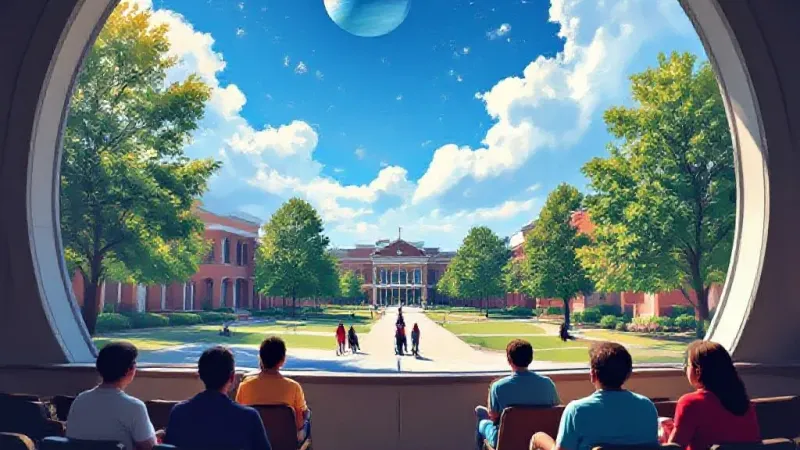
The Valdosta State University Planetarium is offering free telescope presentations and rooftop stargazing opportunities this Friday, October 23, inviting the community to explore the cosmos. These events, suitable for all ages, will provide a unique educational experience featuring astronomy shows and a chance to view celestial objects through telescopes on the rooftop.
Four separate presentations of “Telescopes of Our Past and Future” are scheduled for 6 p.m., 7 p.m., 8 p.m., and 9 p.m. at the VSU Planetarium, which is located on the third floor of Nevins Hall at Valdosta State University. Admission to these shows is free, but seating for each presentation is limited. Free admission tickets will be distributed on a first-come, first-served basis, beginning as early as 5:30 p.m. directly at the VSU Planetarium.
Each presentation will start with “Two Small Pieces of Glass: The Amazing Telescope,” a 23-minute full-dome educational show. This program traces the 400-year history of the telescope, illustrating its evolution and impact on our understanding of the universe. Following the film, the conversation will expand to include the detection of gravitational waves, a modern frontier in astronomy. Guests will also see refractors and reflectors on display, showcasing different types of instruments used to gather light and energy from distant cosmic phenomena.
A highlight of the evening will be the opportunity for guests to use telescopes on the rooftop Observatory deck. From this vantage point, attendees can look at the Moon, planets, and various double stars, guided by the Planetarium staff. Dr. Martha Leake, a professor of astronomy and physics at VSU, stated that these instruments allow us to gather light and energy to "see the past and learn about our future." She noted that telescopes began as simple spyglasses, evolving thanks to figures like Galileo, who first aimed them at the Moon, Sun, planets, comets, and asteroids. This early exploration led to deeper questions about stars, such as their temperature, distance, and whether our Sun is just another nearby star. Dr. Leake explained that the presentations will examine instruments from early "refractors" to large "reflectors," which collect various types of energy to unveil cosmic secrets. She cited the James Webb Space Telescope, Hubble Space Telescope, Nancy Grace Roman Telescope, and the Deep Space Network as examples of innovative telescope design and function, emphasizing, "We ‘travel’ through the Universe with our telescopes."
The VSU Planetarium itself is equipped with a Digitarium Kappa digital projector. This advanced technology allows the facility to accurately reproduce the night sky as it would appear from any location on Earth, or even from the surface of other objects within our solar system, at any point in history—past or future. For those planning to attend, limited parking is available directly in front of Nevins Hall and across Patterson Street. Public outreach shows at the Planetarium are designed to be appropriate and engaging for all ages, making it a family-friendly event. For additional information, interested individuals may contact VSU’s Department of Data Science at (229) 333-5778.